Last updated: March 2025
Modern GS1 barcodes such as Digital Link QR codes, Data Matrix barcodes, and GS1-128 barcodes are capable of encoding multiple different data points, such as a GTIN in combination with a batch number and expiry date. A GS1 Application Identifier (AI) is a numeric prefix before each data point that identifies the exact data that follows, and defines the rules for that data point, such as the length of the data field and the characters permitted.
To understand this further, let’s look at an example of a GS1-128 linear barcode for a carton of strawberry clamshells:
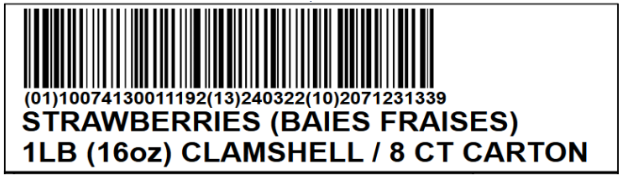
The number below the barcode is called the “Human Readable Interpretation” of the data actually inside the barcode. In this example, the data is:
(01)100741300111192(13)240322(10)2071231339
Notice the numbers within brackets — these are GS1 Application Identifiers. Each AI is a standardised numeric code, typically two to four digits long. They “identify” the purpose (or the “application”) of the data that directly follows.
The application identifier “01” means “Global Trade Item Number” (GTIN), which identifies the type of product being sold.
What kind of information can Application Identifiers represent?
There are over 100 application identifiers defined today. These include:
- GS1 Identification Keys: dedicated to uniquely identifying objects in the supply chain, including Global Trade Item Number (GTIN), Global Location Number (GLN) and Serial Shipping Container Code (SSCC)
- Trade Item Attributes: such as lot number, expiry date, net weight
- Logistic Unit Attributes: such as gross weight, volume, routing code, item count
- Special Purpose Identifiers: such as shipment and consignment identification, couponing, additional identifiers, and customer specific fields
Where are GS1 Application Identifiers defined?
The codes and the rules for the data that follow are all defined in a document called the GS1 General Specifications (link here).

Let’s use the General Specs to look up the definition of one of the keys in our previous example:

In the table of contents, we can see a section that describes application identifiers beginning with one. The application identifier we are looking for is “13”, which is the “Packaging Date” of the food:

The section provides the reader with the definition and rules of the data field:

Quick reference site for Application Identifier lookup
The GS1 reference site https://ref.gs1.org/ai/ is a great quick reference to find out what an application identifier code means. Simply go to the site and punch in the number to filter the list.

More examples: GS1 Digital Links
Application identifiers are also present in GS1 Digital Links. Consider the following example from GS1:
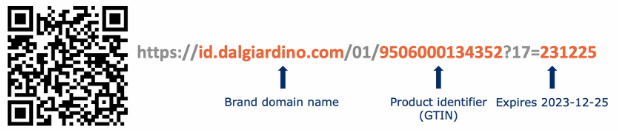
A Digital Link is a web address that is structured in a special way. It can carry multiple pieces of data — and each data element is prefixed by a GS1 Application Identifier. In the example above, the product identifier (GTIN) is prefixed by “01” — the application identifier for GTIN. An expiration date has also been encoded into the Digital Link — it is prefixed with “17”, which is the application identifier for “Expiration date”.
To learn more about GS1 Digital Link, see our in-depth guide here.
Conclusion
With the GS1 Sunrise 2027 initiative, retailers and supply chain companies will be able to leverage the power of 2D barcodes such as GS1 Digital Links in QR codes. Hundreds of different data elements could potentially be encoded into 2D barcodes. GS1 Application Identifiers are the definition of these data elements.